
How to play
Pick a game. Learn it in about two minutes.
Every game here is built to explain itself, but a quick walkthrough never hurts. Below is a plain-English guide to each one — how to set it up, how a round works, and how to win — with pictures of the real screens.
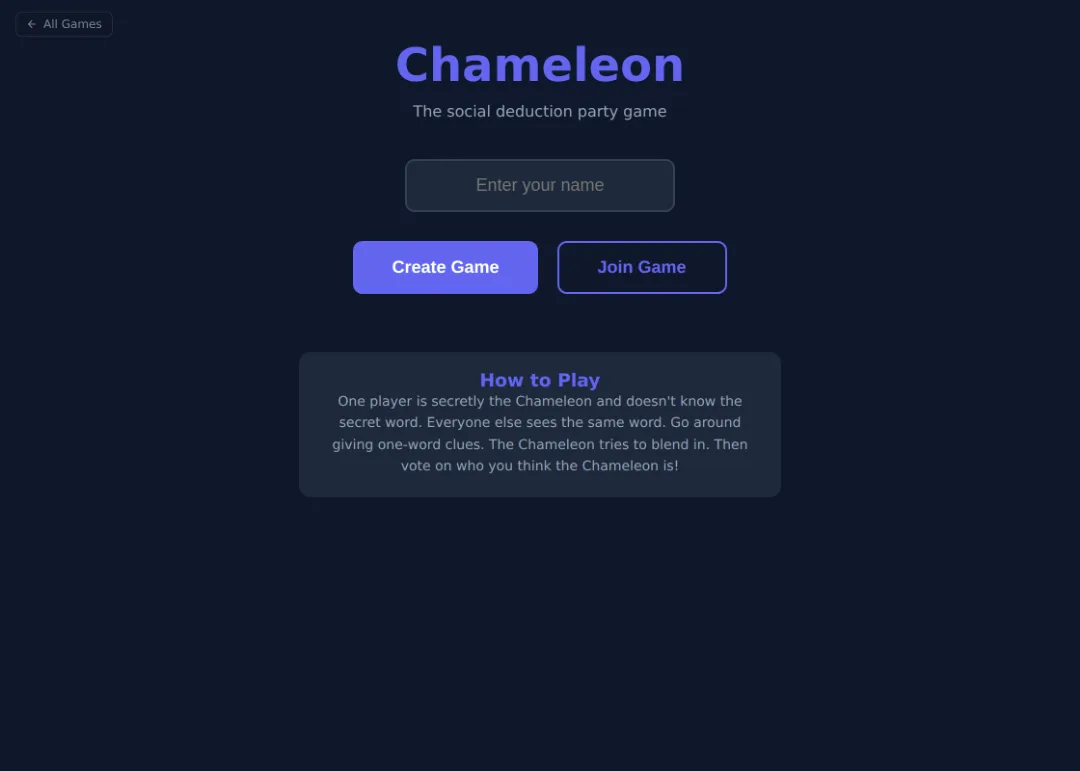
Chameleon
Everyone sees the same secret word — except one hidden Chameleon. Give one-word clues out loud, blend in, and sniff out the faker before they slip away.
▶ Play Chameleon- One person taps Create Game and reads out the room code. Everyone else opens the page, taps Join Game, and enters the code and their name.
- When everyone's in, the host taps Start and a secret word is dealt to the group.
- Everyone secretly sees the same word — except the Chameleon, whose screen just says “You are the Chameleon.”
- Tap the dice to pick who gives a clue first.
- Go around the room. Each person says one word that relates to the secret word — out loud. Too obvious and you hand it to the Chameleon; too vague and you look guilty.
- Talk it over, then the host opens the vote. Everyone taps who they think the Chameleon is.
- The host reveals the result — Caught or Escaped — and the secret word.
The group wins by voting out the Chameleon. The Chameleon wins by blending in and avoiding the vote. Play several rounds and keep score.
Give a clue that proves you know the word without spelling it out. The best clues are true but sideways.
Bible Charades
Act out well-known Bible stories against the clock. No phones needed — just gather around one screen. Eighty-plus curated stories in easy, medium, and hard.
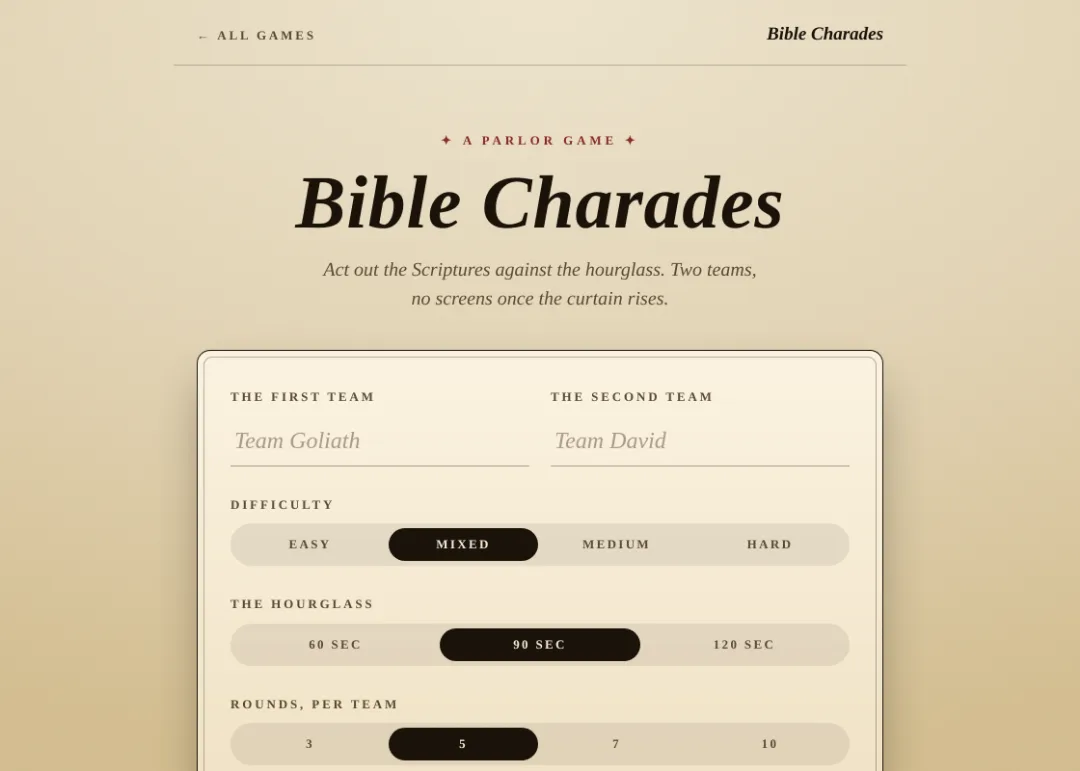
▶ Play Bible Charades- Name your two teams (there are playful defaults like Team Goliath and Team David).
- Pick a difficulty (Easy, Mixed, Medium, or Hard), a timer (60 / 90 / 120 seconds), and how many rounds to play.
- Tap Start Game.
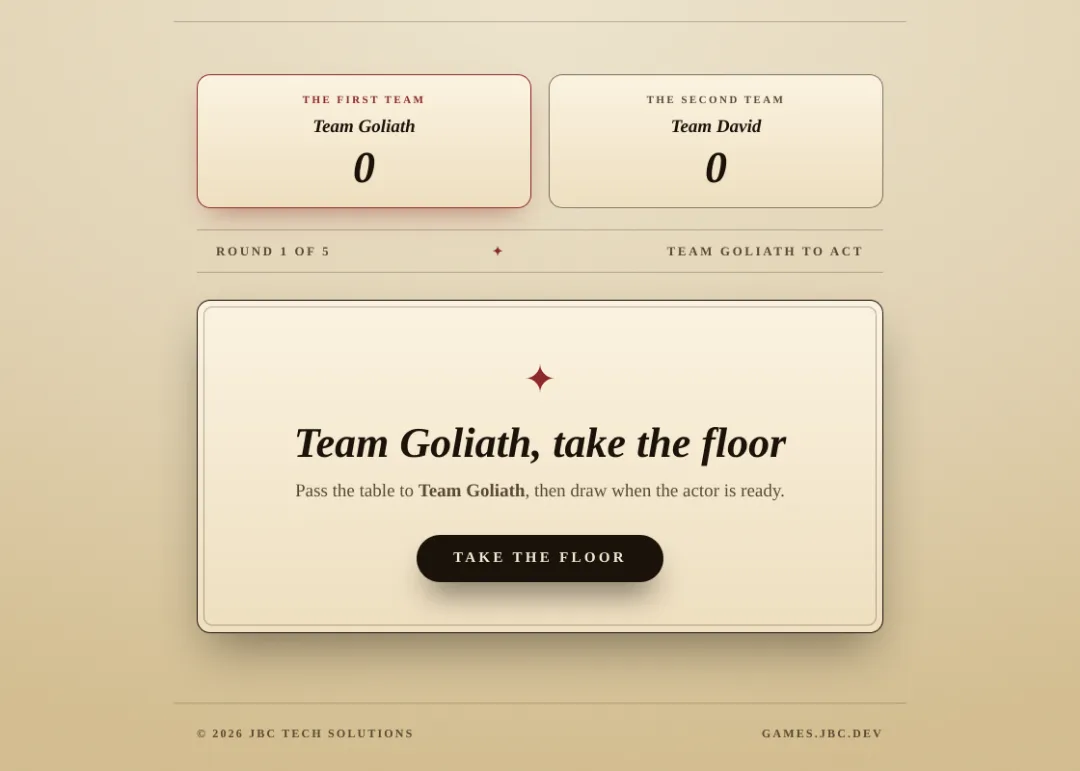
- One actor on the active team taps to reveal a story only they can see.
- They act it out — no talking, no sound effects, no mouthing words.
- Their teammates shout guesses before the timer runs out.
- Mark it guessed for the point, or skip to the next story.
- Time's up — pass the screen to the other team.
Highest score after the set number of rounds takes it. Want your own stories? You can add them to the deck.
Break the story into beats — who's in it, where it happens, what changes — and act the beats in order.
Quiz Night
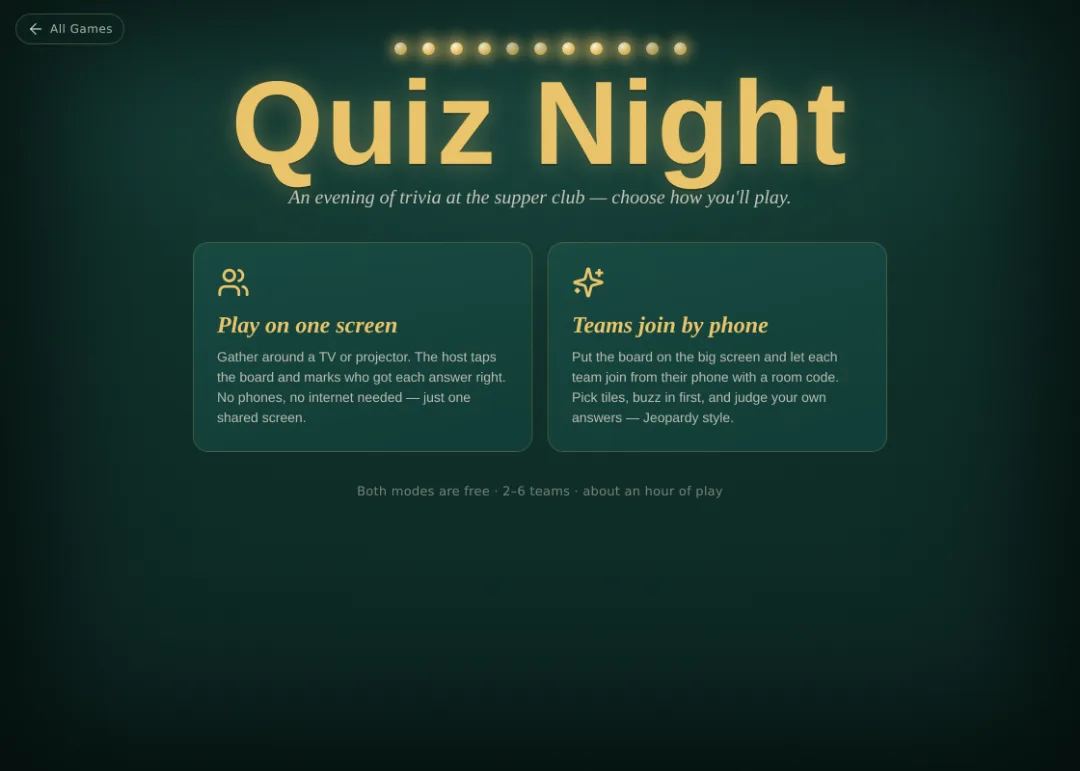
A vintage supper-club trivia night mixing Bible and clean general knowledge. Play two ways: local on one shared screen, or online with teams buzzing in from their phones.
▶ Play Quiz Night- Choose Play local and add your teams.
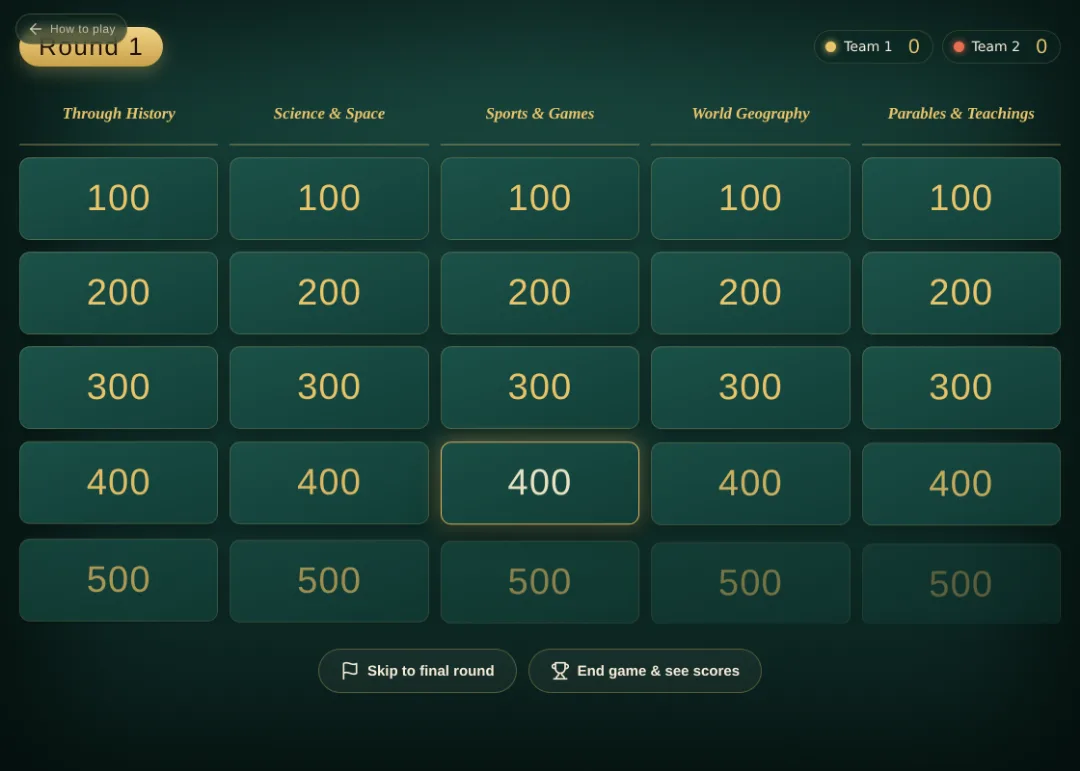
- A jeopardy-style board of categories and point values appears.
- Tap a tile, read the clue aloud, and let a team answer. Award the points (or dock them).
- Round two doubles every value; finish with a final wager where teams bet their score on one last question.
- Choose Play online. The host screen shows a room code.
- Each team joins from a phone and buzzes in — first to buzz gets to answer.
- The host marks it right or wrong and the board updates live for everyone.
Highest score after the final wager wins. Because the wager risks your whole score, a team in last place can still steal the night.
STEM Jeopardy
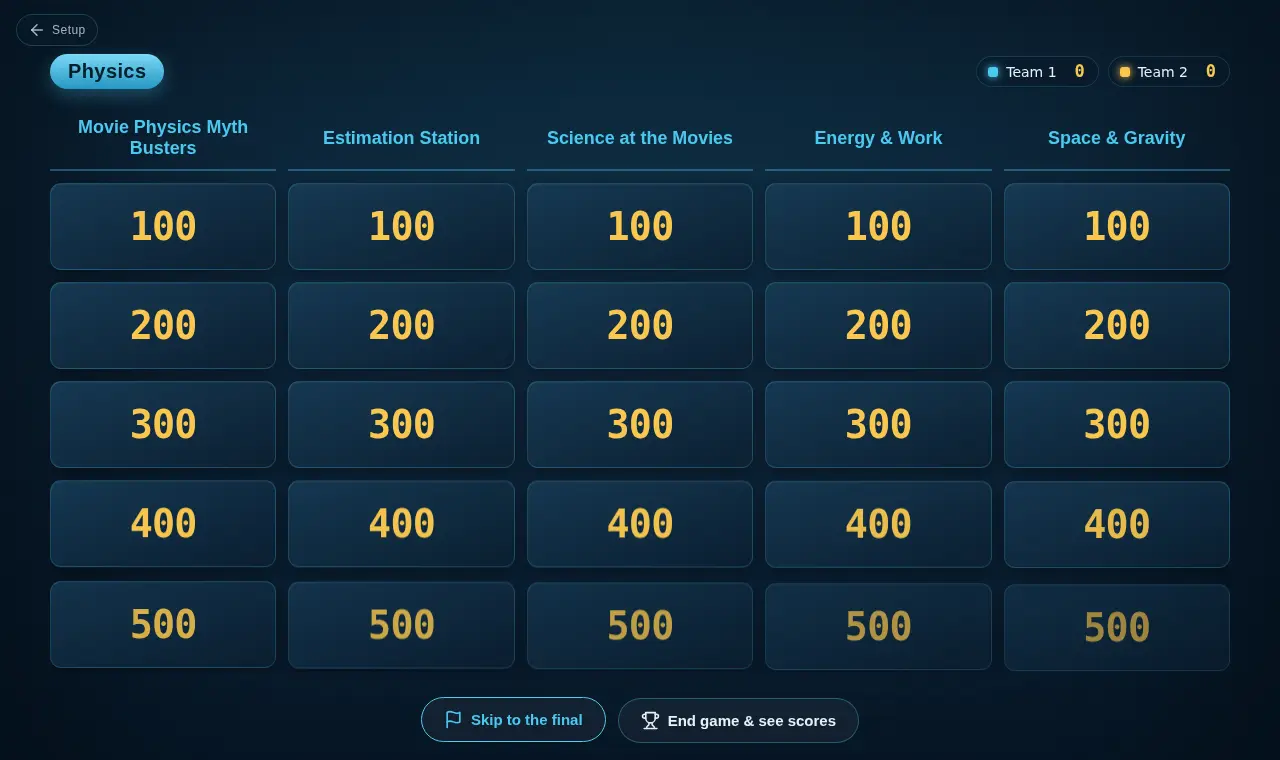
Quiz Night built for a classroom. Pick the class, pick how much of the period you have, and play a board that mixes course questions with brain teasers and movie-science myth busting — or the all-subject board that puts English, history, science, math, Bible, and a fun category up at once. No prep, no accounts, nothing to install.
▶ Play STEM Jeopardy- Pick the class pack: Algebra & Geometry (9–10), Biology (9–10), Pre-Calc / Algebra II / Geometry (11–12), Physics (11–12), or All-Subject Challenge (9–12) — six hard columns of English, history, science, math, Bible, and a fun category.
- Pick the length: one round (~25 minutes) or two rounds and a final (a full period).
- Pick the answer timer — off, or 20 / 30 / 45 / 60 seconds a question — and whether it beeps.
- Name the teams — anywhere from 2 to 8 — and start. Open the answer key first if you want a printed copy of the exact board you are about to play.
- A team picks a category and a value. Read the question off the projector — the timer starts on its own, and Pause or Reset are right there when you need them.
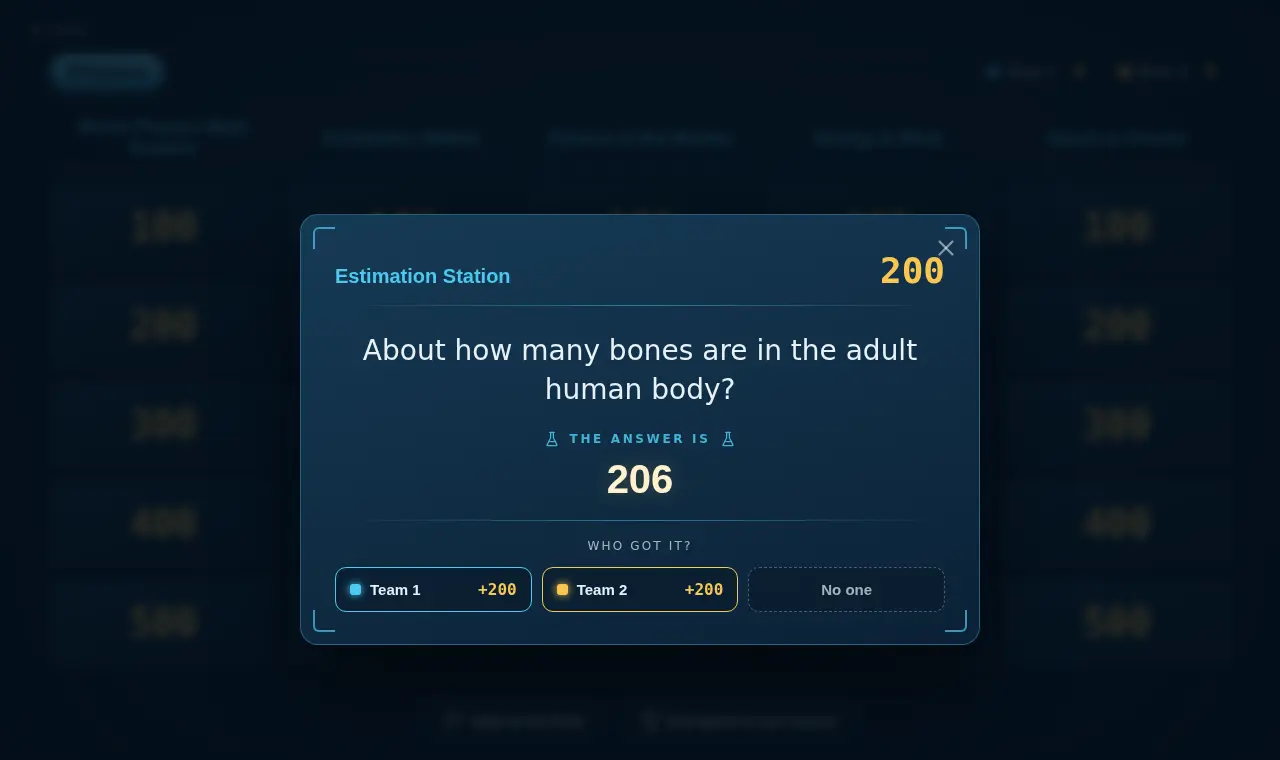
- Tap Reveal answer — some answers come with a one-line "why" to talk through.
- Tap the team that got it, or No one. Points are automatic.
- One tile per round is a hidden Bonus Lab worth double. Round two doubles every value, and the final question lets each team wager up to its whole score — its timer runs double the length and waits for you to press Start.
- Every board has a 6-character board code, shown on setup. The same code with the same class and length always deals the same board.
- Copy board link gives you a URL that preloads that exact board — or type the code into the CODE box and press Load.
- Shuffle a new board deals a fresh one. Handy for running one board across every period, or for printing a key today for a game you play next week.
- Press Key on 2nd screen — the answer key opens in its own window. Drag it to your laptop display and leave the board on the projector.
- It shows the same board, not a new one: both screens print a matching board code.
- In the same browser it keeps up live — questions grey out as they are played, and it follows you if you deal a new board. Copy link opens the key on a phone or tablet instead (right board, no live marks).
On the four class packs, nothing on the board assumes you have taught anything yet — every question probes prior knowledge or reasoning. The answer key lists what each category gauges, so the questions that stall the room tell you where to start. All-Subject Challenge is the exception: it is a hard review board, not a diagnostic.
Highest score after the final question. Because the wager risks a team's whole score, the last-place table can still take it on the final.

Codenames
Two teams of secret agents race to find their own words on a shared 5×5 board from one-word clues — while dodging the other team's cards and the game-ending assassin.
▶ Play Codenames- One device hosts the board — open it on a TV or laptop. It shows all 25 words but never the secret key.
- Players join on phones with the room code and pick a team (Red or Blue) and a role: Spymaster (sees the key) or Guesser.
- Each team needs one Spymaster and at least one Guesser. The host starts the game.
- The Spymaster gives one word and a number — e.g. “Nature 2” — hinting at that many of their team's words.
- Their Guessers tap the words they think belong to their team.
- Correct → keep guessing (up to the number, plus one bonus). A bystander or the other team's word ends your turn. The assassin loses the game instantly.
- Teams alternate until someone finds all their agents.
First team to reveal all its agents wins. Reveal the assassin and your team loses on the spot.
The number is a promise. One clever clue can link several words — but a stretch can send your guessers straight to the assassin.
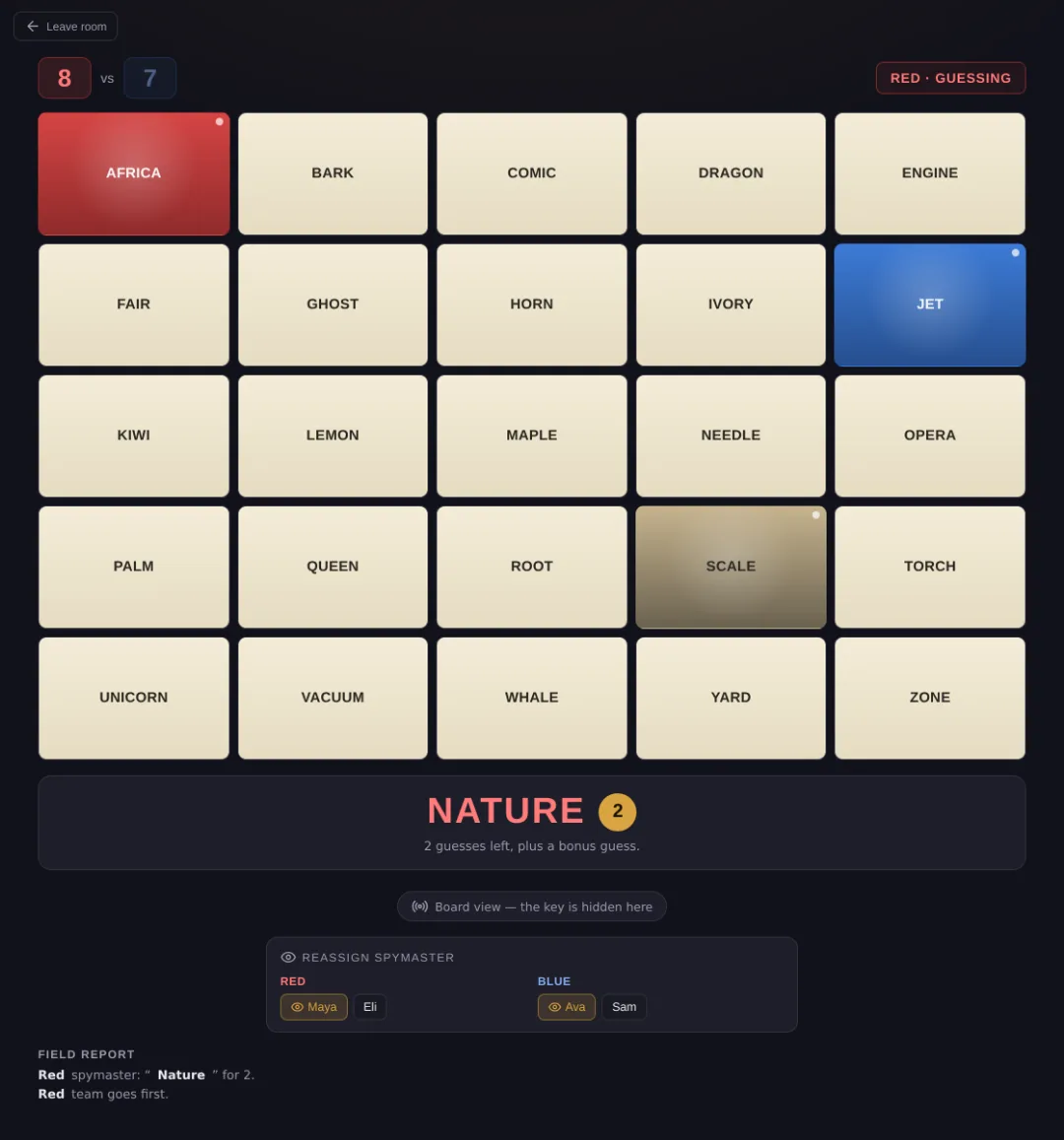
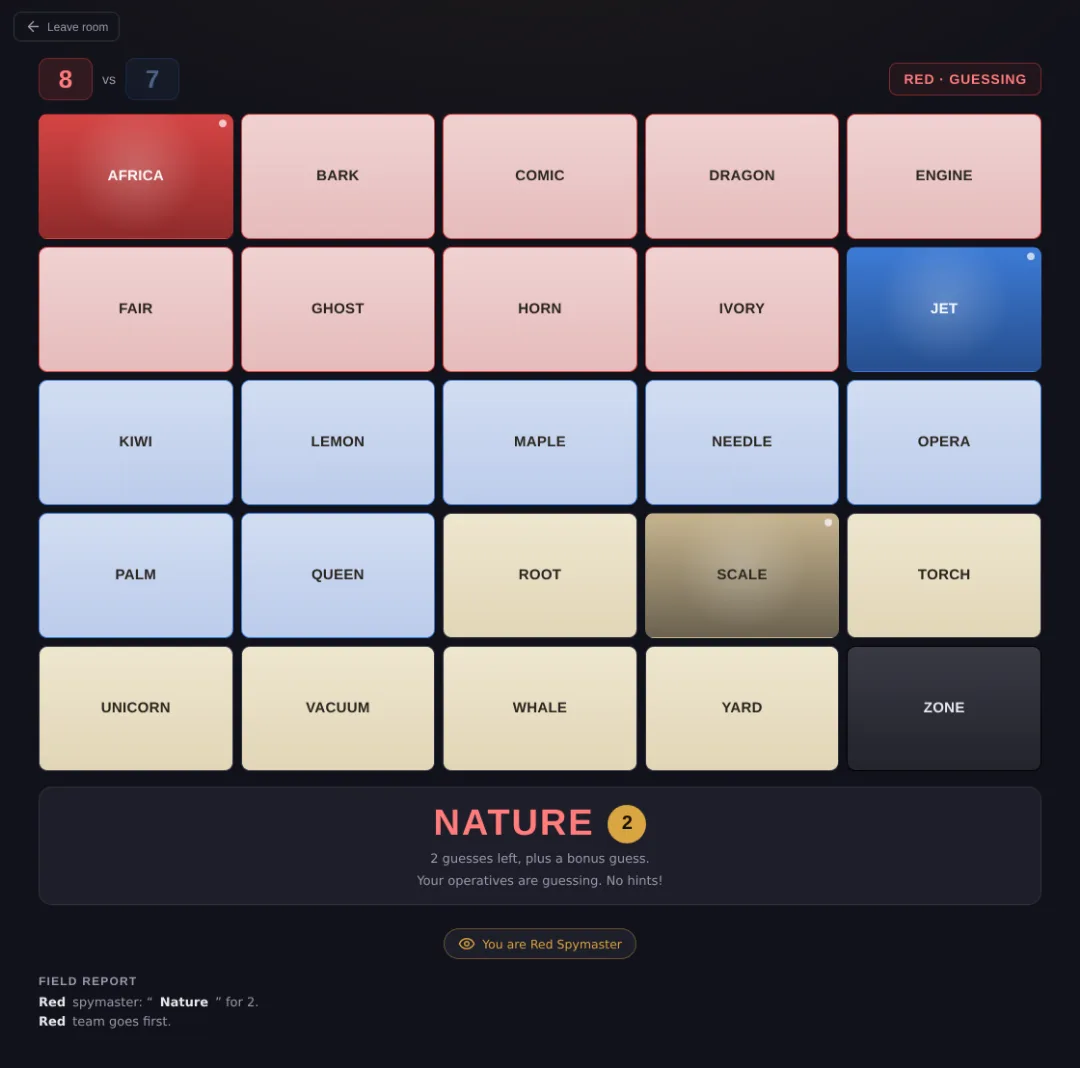
- Your agents
- The words your team must uncover — red for Red, blue for Blue. Find all of yours to win.
- The other team's agents
- Tap one by mistake and your turn ends — and you've handed them a free reveal.
- Bystanders
- Innocent tan cards. No harm done, but revealing one immediately ends your turn.
- The assassin
- One black card. Reveal it and your team loses instantly — the whole reason a Spymaster's clue has to be careful.
The host board and the Guessers only see a card's color after it's tapped — only the Spymasters see the full key from the start.
Sabotage
A failing starship. The loyal Crew race to install repairs, while a hidden ring of Saboteurs — led by one secret Mastermind — work to seize control. Trust no one.
▶ Play Sabotage- One device hosts the Bridge (a TV or laptop). It shows the shared board and holds no secrets.
- Five to ten players join on their phones with the room code.
- The host launches, and everyone is secretly dealt a role on their own phone: loyal Crew, a hidden Saboteur, or the one Mastermind. Saboteurs learn who their ring-mates are.
- The Captain nominates a First Officer.
- Every living player votes Aye or Nay on the pairing.
- If it passes, the Captain secretly draws three policies, discards one, and hands two to the First Officer, who installs one — a Repair or a Sabotage.
- Each Sabotage hands the Captain a power: scan a player's allegiance, hand off command, recon the deck, or eject a player through the airlock.
- Command passes to the next player and a new round begins.
Crew win by installing 5 Repairs or ejecting the Mastermind. Saboteurs win with 6 Sabotages, or by getting the Mastermind elected First Officer once 3 Sabotages are up. Three failed votes in a row surge the reactor and auto-install the top card.
The deck holds 6 Repairs and 11 Sabotages — a bad run of Sabotages can be luck, not treason. Watch who drew and passed each one.
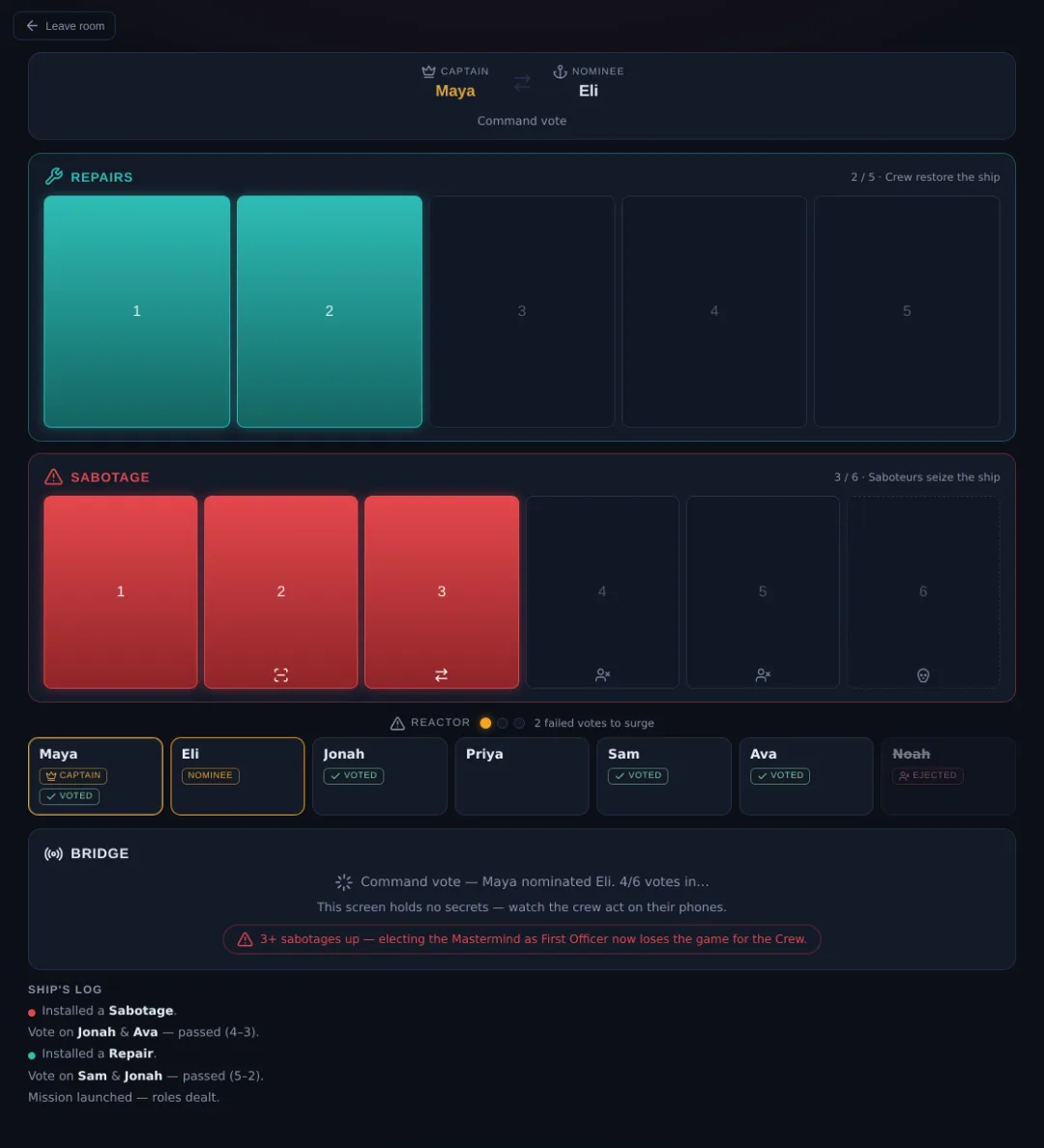
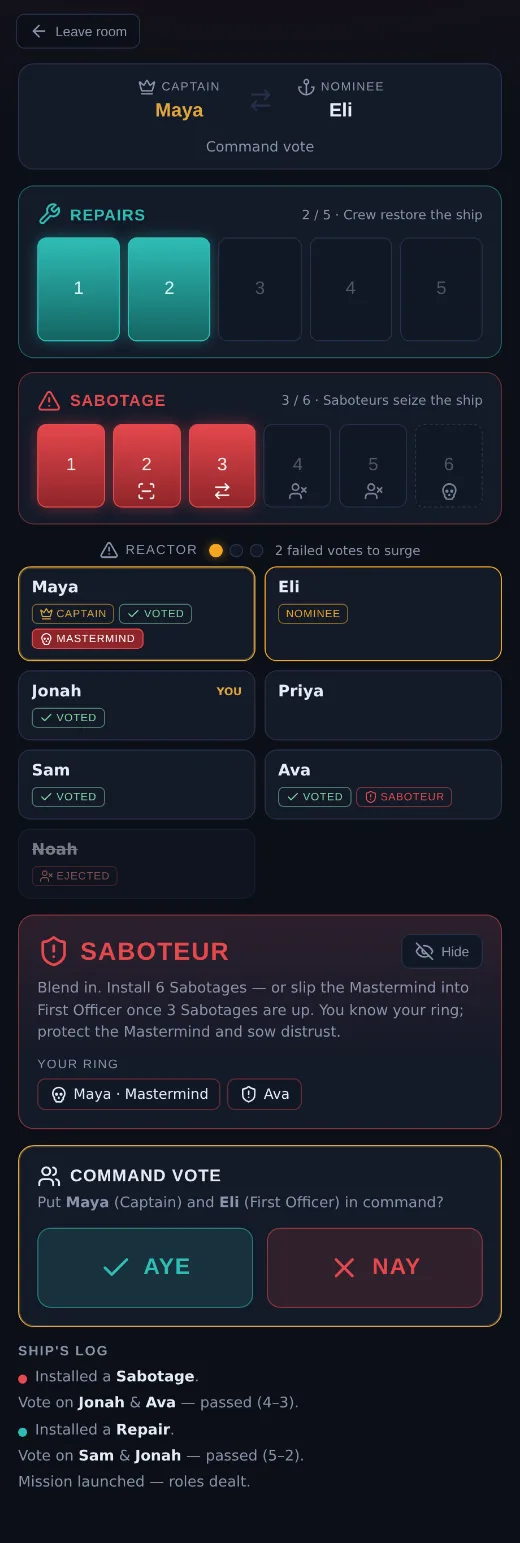
- Repairs track (teal)
- The Crew's progress. Fill all five and the ship is saved — the Crew win.
- Sabotage track (red)
- The Saboteurs' progress; six seizes the ship. The little icon under a slot is the power the Captain gains when that Sabotage is installed.
- The reactor
- Three warning lights. Each failed command vote lights one. On the third, the reactor surges — the top policy auto-installs (nobody gets to choose it) and the lights reset. It's why you can't just keep voting Nay to stall.
- The government
- The current Captain and their nominated First Officer, plus the phase of the round (nominating, voting, installing…).
- Term limits
- The government that just served can't be re-picked right away — so command keeps moving around the table instead of sitting with two players.
- Danger zone
- Once three Sabotages are up, electing the Mastermind as First Officer instantly loses the game for the Crew. The Bridge flashes a warning so nobody does it by accident.
- Veto (abort)
- After five Sabotages, the First Officer may move to abort a policy hand. If the Captain agrees, both cards are discarded — and the reactor ticks up one.
Each Sabotage installed may hand the Captain a one-time power. Which powers are in play depends on the number of players — the exact layout is printed right on the Sabotage track.
- Scan ID — privately learn one player's allegiance: loyal Crew, or part of the Saboteur ring.
- Emergency Command — hand the captaincy to any player for the next round, out of turn.
- Recon — secretly look at the next three policy cards coming off the deck.
- Airlock — eject a player from the ship for good. Eject the Mastermind and the Crew win on the spot — but guess wrong and you've thinned your own side.